
For Strategic Infrastructure and Superstructure Applications In strategic infrastructure and superstructure projects such as motorways, bridges, viaducts and industrial facilities, reinforced concrete elements are exposed to aggressive environmental and chemical conditions. Chemicals used in industrial processes, together with natural factors such as rainwater and moisture, can penetrate the concrete and reach the embedded steel reinforcement.
When aggressive substances penetrate the base concrete, slabs, columns and beams—which act as primary load-bearing elements—corrosion may begin in the reinforcing steel.
Reinforcement embedded in concrete structures, which supports columns, cylinders, heat exchangers and other steel structures, can be adversely affected by exposure to moisture, acidic or alkaline chemicals, and chloride-containing environments. Corrosive ions accelerate the carbonation of the cement paste and reduce the alkalinity (pH level) of the concrete surrounding the steel; this increases the risk of reinforcement corrosion.
Corrosive ions penetrating the concrete disrupt the passive oxide layer that naturally protects the surface of the reinforcing steel, thereby initiating electrochemical corrosion processes. Epoxy-coated reinforcing bars (rebar) are used as a corrosion-protected reinforcement element in reinforced concrete structures. This product provides both structural tensile capacity and enhanced durability under aggressive exposure conditions.
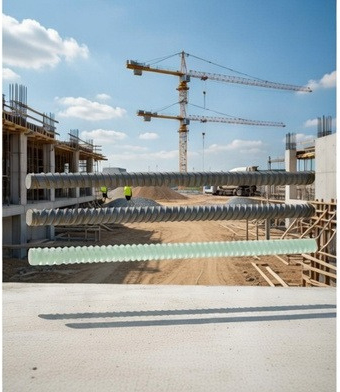
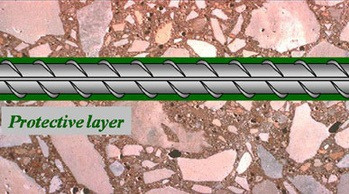
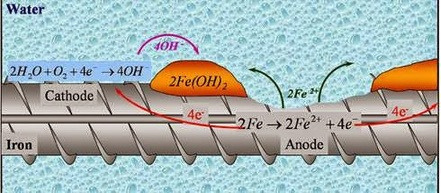
Epoxy-coated rebar is used as a corrosion-protected reinforcement element in reinforced concrete structures. It provides both structural tensile capacity and enhanced durability under severe exposure conditions.
Epoxy-coated rebar plays a critical role in minimising deterioration caused by corrosion; otherwise, this deterioration can lead to cracking and spalling in concrete elements, as well as a reduction in their structural service life.
The internationally recognised standard governing epoxy-coated reinforcing bars is ASTM A 775/775M, which specifies requirements for coating thickness, adhesion, flexibility and quality control.
The first documented application of epoxy-coated steel took place in 1973 during the construction of the Schuylkill River Bridge near Philadelphia in the USA. Initially adopted in North America as the primary method of corrosion protection for reinforced concrete structures, epoxy-coated steel reinforcement is now widely used in countries across the Middle East and Asia under harsh environmental conditions.
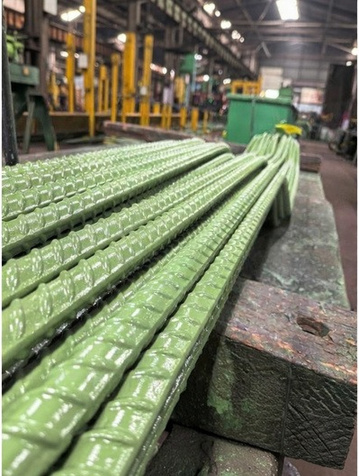
In the United States and Europe, the use of epoxy-coated steel produced in accordance with ASTM standards is widely stipulated as a standard requirement for airport and motorway infrastructure projects.
Concrete surfaces, bridges, viaducts and industrial facilities are exposed to aggressive environmental and chemical conditions such as rainwater, moisture, de-icing salts and industrial chemicals. When these factors penetrate the structural concrete – which acts as the primary load-bearing element – as well as the slabs, columns and beams, they can reach the embedded reinforcing steel and trigger corrosion.
Corrosion processes reduce the alkalinity (pH level) of concrete, which normally provides a protective environment for the reinforcing steel. The deterioration of this protective condition leads to electrochemical reactions occurring on the steel surface. As corrosion progresses, the formation of rust causes volumetric expansion, creating internal stresses within the concrete. This, in turn, leads to cracking, spalling, loss of cross-section in the reinforcing steel, and a reduction in mechanical strength and load-bearing capacity.
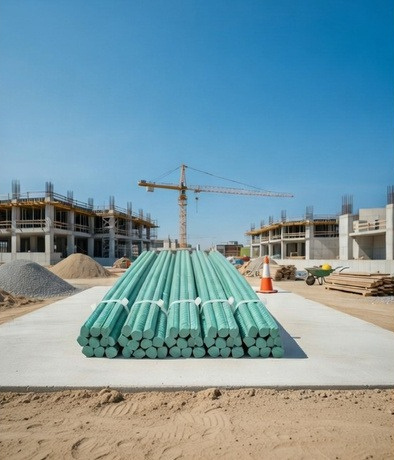
Concrete deterioration and damage to reinforcement not only significantly increase maintenance and repair costs but also pose potential safety risks. Repair works, the replacement of damaged reinforcement and structural reinforcement measures can have significant economic and operational implications.
Epoxy-coated steel acts as a physical and electrochemical barrier on the steel surface, isolating the reinforcement from aggressive environmental factors. By preventing direct contact between corrosive elements and the underlying steel substrate, the epoxy coating significantly increases durability and service life. For this reason, the use of epoxy-coated steel is regarded as a critical durability measure in reinforced concrete construction.
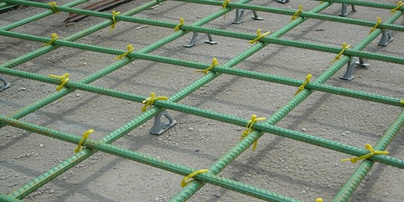
Adhesion of Epoxy-Coated Reinforcing Bars to Concrete
Bonding of Epoxy-Coated Reinforcing Bars to Concrete Contrary to common misconceptions, epoxy-coated reinforcing bars are designed to provide adequate bonding performance with concrete when manufactured and installed in accordance with the relevant standards. Bond between reinforcing steel and concrete is primarily achieved through mechanical interlocking (arising from the profile of the bar), friction and chemical bonding. As the profile of the bar remains intact, the presence of an epoxy coating does not eliminate mechanical interlocking. However, bond performance must be assessed in accordance with applicable specifications and test methods. In materials mechanics, the slope of the stress–strain curve within the elastic region is defined as the Modulus of Elasticity (E), expressed in MPa. This value represents the stiffness of the material and is determined by the initial linear portion of the stress–strain relationship. A higher modulus of elasticity indicates that the material is stiffer, whilst a lower modulus reflects greater flexibility.
The results of tensile tests on epoxy-coated concrete reinforcing bars are evaluated in terms of yield strength, tensile strength, elongation and modulus of elasticity. These mechanical properties demonstrate that epoxy-coated concrete reinforcing bars provide corrosion protection whilst maintaining structural performance characteristics comparable to those of uncoated concrete reinforcing bars. Adhesion performance and mechanical properties must always be verified in accordance with the relevant ASTM standards and project specifications.
| BAR NO | PUBLICATION | MAXIMUM APPLIED LOAD | DEVIATION | BOND STRENGTH MPA | ||
|---|---|---|---|---|---|---|
| KN | TON | FRONT SIDE | BACK SIDE | |||
| REBAR 1 | EPOXY COATED 1 | 175,3 | 17,6 | 0,10 | 1,05 | 9,22 |
| REBAR 2 | EPOXY COATED 2 | 175,3 | 17,6 | 0,07 | 1,04 | 9,22 |
| REBAR 3 | EPOXY COATED 3 | 175,3 | 17,6 | 0,06 | 1,09 | 9,22 |
| REBAR 4 | UNCOATED 1 | 169,7 | 17 | 0,10 | 0,64 | 8,93 |
| REBAR 5 | UNCOATED 2 | 150,2 | 15 | 0,48 | 0,90 | 7,90 |
| REBAR 6 | UNCOATED 3 | 169,7 | 17 | 0,73 | 1,22 | 8,93 |